
-
-
-
-
SERVICE

-
JOIN US

-
CONTACT US



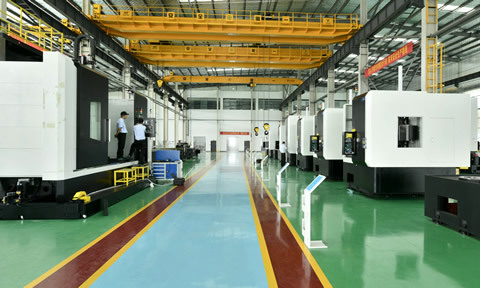

The difference between vertical machining centers and horizontal machining centers, and how to choose the right machine tool for you.
Release time:
2021-11-09
Vertical machining center: The spindle is in a vertical position, and the structure is mostly a fixed column. The worktable is rectangular and does not have indexing rotation functionality. It typically has two or three linear motion coordinate axes and can be equipped with a rotary table that rotates along a horizontal axis on the worktable for machining helical parts.
There are significant differences between vertical machining centers and horizontal machining centers in several aspects. The following are the main differences between the two.
1. Spindle and Worktable Layout
Vertical Machining Center: The spindle is in a vertical position, and the structure is mostly a fixed column. The worktable is rectangular and does not have indexing rotation functionality. It typically has two or three linear motion coordinate axes and can be equipped with a rotary table that rotates along the horizontal axis for machining spiral parts.
Horizontal Machining Center: The spindle is in a horizontal position and usually comes with an automatic indexing rotary worktable. It generally has 3 to 5 motion coordinates, commonly three linear motion coordinates plus one rotary motion coordinate. After a single clamping, the workpiece can complete machining on the remaining four surfaces except for the mounting surface and the top surface.
2. Worktable Design
Vertical Machining Center: The worktable is a T-slot worktable with a cross slide structure, with two sets of motion mechanisms responsible for movement in mutually perpendicular directions. The worktable for X-axis feeding is placed on top of the guide rails responsible for Y-axis feeding.
Horizontal Machining Center: The worktable is designed to move only in the X or Y direction, and the worktable is generally a rotating worktable with a grid of threaded holes, which is relatively easy to equip with an exchangeable double worktable.
3. Machining Capability and Application Range
Vertical Machining Center: Suitable for machining discs, sleeves, and plates, and can also process molds and complex small shell parts.
Horizontal Machining Center: Suitable for machining box-type parts, especially for some holes and hole systems on box-type parts, as well as box-type parts with strict dimensional requirements for holes and cavities relative to reference surfaces, which can be easily guaranteed, making it suitable for mass production.
4. Chip Removal and Cooling
Vertical Machining Center: Chip removal is relatively difficult, but the cooling conditions are better, and the cutting fluid can easily reach the cutting area.
Horizontal Machining Center: Chip removal is easy, which is beneficial for machining, but the cooling conditions are not as good as those of vertical machining centers, especially for deep hole boring, milling, drilling, etc., where the cutting fluid has difficulty reaching the cutting depth.
5. Price and Structural Complexity
Vertical Machining Center: The structure is relatively simple, and the price is relatively low, making it more affordable.
Horizontal Machining Center: The structure is more complex, occupies a larger area, and is also more expensive.
6. Coordinate System and Motion Method
Vertical Machining Center: Its Z-axis moves downward to complete machining.
Horizontal Machining Center: Its Z-axis moves downward horizontally to complete machining.
There are significant differences between vertical machining centers and horizontal machining centers in terms of spindle and worktable layout, worktable design, machining capability and application range, chip removal and cooling, price and structural complexity, as well as coordinate system and motion method. Therefore, the choice of which type of machining center to use depends on specific machining needs and workpiece types.




E-mail:meishenmeike@163.com
Zip Code: 226600
Add: No.68,Huangziliang Rd,Qutang Town, Hai'an City,Jiangsu
MEICO

Follow us